
[vc_row bg_type=”bg_color” ult_hide_row=”ult_hide_row_value” ult_hide_row_mobile=”mobile” ult_hide_row_mobile_large=”xl_mobile” css=”.vc_custom_1601853477244{background-position: center !important;background-repeat: no-repeat !important;background-size: cover !important;}” bg_color_value=”#1e223d”][vc_column width=”1/3″][vc_empty_space height=”30″][vc_row_inner][vc_column_inner width=”1/2″][vc_icon icon_fontawesome=”fas fa-search” color=”custom” size=”lg” align=”center” custom_color=”#308fd0″ link=”url:http%3A%2F%2Ftemperaturesensors.us%2Fbrowse%2F|title:Browse|target:%20_blank|”][vc_custom_heading text=”Browse” font_container=”tag:div|font_size:20|text_align:center|color:%23308fd0|line_height:2″ google_fonts=”font_family:Open%20Sans%3A300%2C300italic%2Cregular%2Citalic%2C600%2C600italic%2C700%2C700italic%2C800%2C800italic|font_style:700%20bold%20regular%3A700%3Anormal” el_class=”shorter” link=”url:http%3A%2F%2Ftemperaturesensors.us%2Fbrowse%2F|title:Browse|target:%20_blank|” css=”.vc_custom_1601853503152{margin-top: -15px !important;}”][/vc_column_inner][vc_column_inner width=”1/2″][vc_icon icon_fontawesome=”far fa-file” color=”custom” size=”lg” align=”center” custom_color=”#308fd0″ link=”url:http%3A%2F%2Ftemperaturesensors.us%2Fresources%2Fcertifications%2F|title:Cerifications|target:%20_blank|”][vc_custom_heading text=”Certifications” font_container=”tag:div|font_size:20|text_align:center|color:%23308fd0|line_height:2″ google_fonts=”font_family:Open%20Sans%3A300%2C300italic%2Cregular%2Citalic%2C600%2C600italic%2C700%2C700italic%2C800%2C800italic|font_style:700%20bold%20regular%3A700%3Anormal” el_class=”shorter” link=”url:http%3A%2F%2Ftemperaturesensors.us%2Fresources%2Fcertifications%2F|title:Certifications|target:%20_blank|” css=”.vc_custom_1601853520819{margin-top: -15px !important;}”][/vc_column_inner][/vc_row_inner][vc_empty_space height=”35″][vc_custom_heading text=”Thermocouple Types” font_container=”tag:h4|font_size:14|text_align:center|color:%23efefef|line_height:2″ google_fonts=”font_family:Open%20Sans%3A300%2C300italic%2Cregular%2Citalic%2C600%2C600italic%2C700%2C700italic%2C800%2C800italic|font_style:300%20light%20regular%3A300%3Anormal” el_class=”shorter” link=”|||” css=”.vc_custom_1541181654385{margin-top: -15px !important;}”][vc_tta_accordion color=”white” spacing=”5″ c_align=”center” c_icon=”” active_section=”0″ collapsible_all=”true”][vc_tta_section i_icon_fontawesome=”fa fa-arrow-down” add_icon=”true” title=”Type J Thermocouple” tab_id=”1536783397490-49cc1f16-7aba”][vc_custom_heading text=”Type J Thermocouple” font_container=”tag:h5|font_size:25|text_align:left|color:%23008ad2|line_height:2″ google_fonts=”font_family:Open%20Sans%3A300%2C300italic%2Cregular%2Citalic%2C600%2C600italic%2C700%2C700italic%2C800%2C800italic|font_style:300%20light%20regular%3A300%3Anormal” el_class=”shorter”][vc_empty_space height=”15″][vc_column_text]
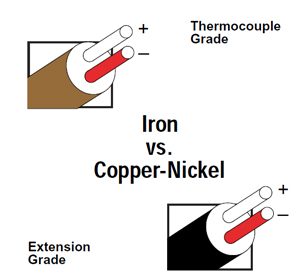
Temperature Range
32 to 1382°F (0 to 750°C)
Accuracy
•Standard Limits: ± 2.2°C or ± 0.75% Tol.
•Special Limits: ± 1.1°C or ± 0.4% Tol.
Type J thermocouples are suitable for use in vacuum, in oxidising and reducing atmospheres or inert gas atmospheres. They are used for temperature measurements 760°C and below.
[/vc_column_text][/vc_tta_section][vc_tta_section i_icon_fontawesome=”fa fa-arrow-down” add_icon=”true” title=”Type K Thermocouple” tab_id=”1536783397571-1af2fb0d-c19b”][vc_custom_heading text=”Type K Thermocouple” font_container=”tag:h5|font_size:25|text_align:left|color:%23008ad2|line_height:2″ google_fonts=”font_family:Open%20Sans%3A300%2C300italic%2Cregular%2Citalic%2C600%2C600italic%2C700%2C700italic%2C800%2C800italic|font_style:300%20light%20regular%3A300%3Anormal” el_class=”shorter”][vc_empty_space height=”15″][vc_column_text]

Temperature Range
–328 to 2282°F (–200 to 1250°C)
Accuracy
•Standard Limits: ± 2.2°C or ± 0.75% Tol.
•Special Limits: ± 1.1°C or ± 0.4% Tol.
Type K Thermocouples are the most common calibration for providing the widest operating range. Recommended for continuous oxidizing or inert atmospheres. Most commonly used for temperatures above 538°C. Not suitable for sulfur environments.
[/vc_column_text][/vc_tta_section][vc_tta_section i_icon_fontawesome=”fa fa-arrow-down” add_icon=”true” title=”Type T Thermocouple” tab_id=”1536793668719-422740b1-5519″][vc_custom_heading text=”Type T Thermocouple” font_container=”tag:h5|font_size:25|text_align:left|color:%23008ad2|line_height:2″ google_fonts=”font_family:Open%20Sans%3A300%2C300italic%2Cregular%2Citalic%2C600%2C600italic%2C700%2C700italic%2C800%2C800italic|font_style:300%20light%20regular%3A300%3Anormal” el_class=”shorter”][vc_empty_space height=”15″][vc_column_text]
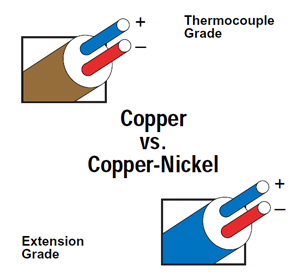
Temperature Range
-454 to 700F(-270 to 370C)
Accuracy
• Standard Limits: ± 2.2°C or ± 0.75% Tol.
• Special Limits: ± 1.1°C or ± 0.4% Tol.
Suitable in oxidizing, reducing, or inert atmospheres as well as vaccuum. Moisture resistant and very stable. This type is best suited for low temperature service. Because of its stability at lower temperatures, this is a superior thermocouple for a wide variety of applications in low and cryogenic
[/vc_column_text][/vc_tta_section][vc_tta_section i_icon_fontawesome=”fa fa-arrow-down” add_icon=”true” title=”Type N Thermocouple” tab_id=”1536793680124-2cc9be9c-4511″][vc_custom_heading text=”Type N Thermocouple” font_container=”tag:h5|font_size:25|text_align:left|color:%23008ad2|line_height:2″ google_fonts=”font_family:Open%20Sans%3A300%2C300italic%2Cregular%2Citalic%2C600%2C600italic%2C700%2C700italic%2C800%2C800italic|font_style:300%20light%20regular%3A300%3Anormal” el_class=”shorter”][vc_empty_space height=”15″][vc_column_text]
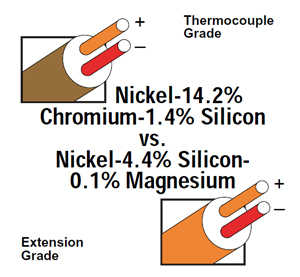
Temperature Range
–454 to 2,300F (–270 to 1260C)
Accuracy
•Standard Limits: ± 2.2°C or ± 0.75% Tol.
•Special Limits: ± 1.1°C or ± 0.4% Tol.
Type N thermocouples are suitable for use in oxidising atmospheres, in inert gas atmospheres or dry reduction atmospheres. They are very accurate at high temperatures. The source voltage(EMF) and the temperature range are almost the same as with type K.
[/vc_column_text][/vc_tta_section][vc_tta_section i_icon_fontawesome=”fa fa-arrow-down” add_icon=”true” title=”Type E Thermocouple” tab_id=”1536793687731-da908ba0-2d9d”][vc_custom_heading text=”Type E Thermocouple” font_container=”tag:h5|font_size:25|text_align:left|color:%23008ad2|line_height:2″ google_fonts=”font_family:Open%20Sans%3A300%2C300italic%2Cregular%2Citalic%2C600%2C600italic%2C700%2C700italic%2C800%2C800italic|font_style:300%20light%20regular%3A300%3Anormal” el_class=”shorter”][vc_empty_space height=”15″][vc_column_text]
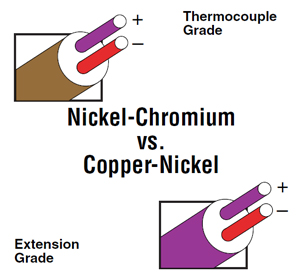
Temperature Range
-454 to 1600F(-270 to 870C)
Accuracy
•Standard Limits: ± 2.2°C or ± 0.75% Tol.
•Special Limits: ± 1.1°C or ± 0.4% Tol.
The Type E thermocouple is suitable for use in vacuum, inert, mildly oxidizing or reducing atmosphere. Not subject to corrosion at cryogenic temperatures. This thermocouple has the highest EMF output per degree of all the only used thermocouples.
[/vc_column_text][/vc_tta_section][vc_tta_section i_icon_fontawesome=”fa fa-arrow-down” add_icon=”true” title=”Type B Thermocouple” tab_id=”1536793803995-004bf661-2bfc”][vc_custom_heading text=”Type B Thermocouple” font_container=”tag:h5|font_size:25|text_align:left|color:%23008ad2|line_height:2″ google_fonts=”font_family:Open%20Sans%3A300%2C300italic%2Cregular%2Citalic%2C600%2C600italic%2C700%2C700italic%2C800%2C800italic|font_style:300%20light%20regular%3A300%3Anormal” el_class=”shorter”][vc_empty_space height=”15″][vc_column_text]
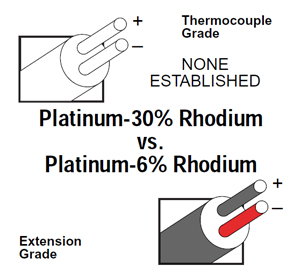
Temperature Range
1475 to 3270°F (800 to 1800°C)
Accuracy
•Standard Limits: ± 2.2°C or ± 0.75% Tol.
•Special Limits: ± 1.1°C or ± 0.4% Tol.
Type B thermocouples are recommended for use in clean air at temperatures from 870 to 1700°C (1600 to 3100°F). They may be used for brief periods in vacuum, but should not be used in reducing atmospheres nor where exposed to nonmetallic or metallic vapors.
[/vc_column_text][/vc_tta_section][vc_tta_section i_icon_fontawesome=”fa fa-arrow-down” add_icon=”true” title=”Type R Thermocouple” tab_id=”1536793806857-b802c655-4fc5″][vc_custom_heading text=”Type R Thermocouple” font_container=”tag:h5|font_size:25|text_align:left|color:%23008ad2|line_height:2″ google_fonts=”font_family:Open%20Sans%3A300%2C300italic%2Cregular%2Citalic%2C600%2C600italic%2C700%2C700italic%2C800%2C800italic|font_style:300%20light%20regular%3A300%3Anormal” el_class=”shorter”][vc_empty_space height=”15″][vc_column_text]
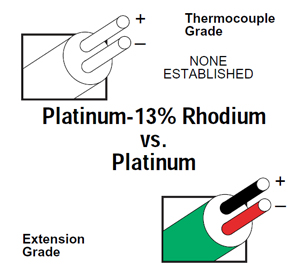
Temperature Range
-58 to 2700F (-50 to 1480C))
Accuracy
•Standard Limits: ± 2.2°C or ± 0.75% Tol.
•Special Limits: ± 1.1°C or ± 0.4% Tol.
Type R thermocouple has superior mechanical properties to Type S and is recommended for continuous use in oxidizing and inert atmospheres around temperatures up to 1400°C and intermittently up to 1600°C. Reducing atmospheres may cause excessive grain growth and drifts in calibration.
[/vc_column_text][/vc_tta_section][vc_tta_section i_icon_fontawesome=”fa fa-arrow-down” add_icon=”true” title=”Type S Thermocouple” tab_id=”1536793810651-7391f89a-e8eb”][vc_custom_heading text=”Type S Thermocouple” font_container=”tag:h5|font_size:25|text_align:left|color:%23008ad2|line_height:2″ google_fonts=”font_family:Open%20Sans%3A300%2C300italic%2Cregular%2Citalic%2C600%2C600italic%2C700%2C700italic%2C800%2C800italic|font_style:300%20light%20regular%3A300%3Anormal” el_class=”shorter”][vc_empty_space height=”15″][vc_column_text]
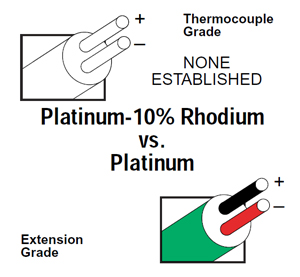
Temperature Range
-58 to 2700F (-50 to 1480C)
Accuracy
•Standard Limits: ± 2.2°C or ± 0.75% Tol.
•Special Limits: ± 1.1°C or ± 0.4% Tol.
Type S thermocouples are suitable for continuous use in oxidizing or inert atmospheres at temperatures up to 1600 °C. They can not be inserted in a metallic protection tube. Beware of embrittlement due to contamination.
[/vc_column_text][/vc_tta_section][/vc_tta_accordion][vc_empty_space height=”20″][/vc_column][vc_column width=”2/3″ css=”.vc_custom_1536769304127{margin-top: -5px !important;margin-right: -5px !important;}”][vc_empty_space height=”20″][vc_custom_heading text=”Thermocouple” font_container=”tag:h1|font_size:40|text_align:left|color:%23ffffff|line_height:2″ google_fonts=”font_family:Open%20Sans%3A300%2C300italic%2Cregular%2Citalic%2C600%2C600italic%2C700%2C700italic%2C800%2C800italic|font_style:800%20bold%20regular%3A800%3Anormal” el_class=”shorter”][vc_custom_heading text=”Sensors” font_container=”tag:h1|font_size:40|text_align:left|color:%23ffffff|line_height:2″ google_fonts=”font_family:Open%20Sans%3A300%2C300italic%2Cregular%2Citalic%2C600%2C600italic%2C700%2C700italic%2C800%2C800italic|font_style:300%20light%20regular%3A300%3Anormal” el_class=”shorter” css=”.vc_custom_1541456349049{margin-top: -45px !important;}”][vc_column_text][aws_search_form][/vc_column_text][vc_empty_space height=”12″][vc_column_text css=”.vc_custom_1541181778601{margin-top: -30px !important;}”]Suggestions:[/vc_column_text][vc_empty_space height=”8″][vc_row_inner css=”.vc_custom_1536769510361{margin-bottom: 0px !important;padding-bottom: 0px !important;}”][vc_column_inner width=”1/3″][vc_btn title=”Thermocouple Standard Plug” style=”outline” color=”primary” size=”xs” align=”center” i_align=”right” i_icon_fontawesome=”” add_icon=”true” link=”url:http%3A%2F%2Ftemperaturesensors.us%2Fproducts%2Fthermocouple-with-plug-jack-standard%2F|||” css=”.vc_custom_1601853534531{margin-top: -40px !important;}”][/vc_column_inner][vc_column_inner width=”1/3″][vc_btn title=”Exposed Thermocouple” style=”outline” color=”peacoc” size=”xs” align=”center” i_align=”right” i_icon_fontawesome=”fa fa-arrow-right” add_icon=”true” link=”url:http%3A%2F%2Ftemperaturesensors.us%2Fproducts%2Fexposed-thermocouple%2F|||” css=”.vc_custom_1594169192031{margin-top: -38px !important;}”][/vc_column_inner][vc_column_inner width=”1/3″][vc_btn title=”Bare Lead Thermocouple” style=”outline” color=”primary” size=”xs” align=”center” i_align=”right” i_icon_fontawesome=”” add_icon=”true” link=”url:http%3A%2F%2Ftemperaturesensors.us%2Fproducts%2Fbare-lead-thermocouple%2F|||” css=”.vc_custom_1601853545310{margin-top: -38px !important;}”][/vc_column_inner][/vc_row_inner][vc_row_inner css=”.vc_custom_1536769510361{margin-bottom: 0px !important;padding-bottom: 0px !important;}”][vc_column_inner width=”1/3″][vc_btn title=”Connection Head” style=”outline” color=”peacoc” size=”xs” align=”center” i_align=”right” i_icon_fontawesome=”fa fa-arrow-right” add_icon=”true” link=”url:http%3A%2F%2Ftemperaturesensors.us%2Fproducts%2Fthermocouple-connection-head%2F|||”][/vc_column_inner][vc_column_inner width=”1/3″][vc_btn title=”Thermocouples w/ Mini Plug” style=”outline” color=”primary” size=”xs” align=”center” i_align=”right” i_icon_fontawesome=”” add_icon=”true” link=”url:http%3A%2F%2Ftemperaturesensors.us%2Fproducts%2Fthermocouple-with-mini-plug-mini-jack%2F|||”][/vc_column_inner][vc_column_inner width=”1/3″][vc_btn title=”Bolt-on Thermocouple” style=”outline” color=”info” size=”xs” align=”center” i_align=”right” i_icon_fontawesome=”fa fa-arrow-right” add_icon=”true” link=”url:http%3A%2F%2Ftemperaturesensors.us%2Fproducts%2Fbolt-on-thermocouple-flat-tip-w-mounting-hole%2F|||”][/vc_column_inner][/vc_row_inner][vc_tta_tabs active_section=”1″ css=”.vc_custom_1543276580531{border-radius: 1px !important;}”][vc_tta_section i_icon_fontawesome=”fa fa-plug” add_icon=”true” title=”What is a Thermocouple?” tab_id=”1541174258403-cc911165-b6cb”][vc_empty_space height=”15″][vc_custom_heading text=”What is a Thermocouple?” font_container=”tag:h5|font_size:20|text_align:left|color:%23727272|line_height:2″ google_fonts=”font_family:Open%20Sans%3A300%2C300italic%2Cregular%2Citalic%2C600%2C600italic%2C700%2C700italic%2C800%2C800italic|font_style:300%20light%20regular%3A300%3Anormal” el_class=”shorter”][vc_empty_space height=”15″][vc_single_image image=”4315″ img_size=”medium”][vc_column_text]
A thermocouple (T/C) is a closed-circuit thermoelectric temperature sensing device consisting of two wires of dissimilar metals joined at both ends of temperature measurements. [showhide style=”color: #00c6f4;” type=”post” more_text=”Learn More” less_text=”Hide” hidden=”yes”]
A current is created when the temperature at one end or junction differs from the temperature at the other end. This phenomenon is known as the Seebeck effect, which is the basis for thermocouple temperature measurements.
One end is referred to as the hot junction whereas the other end is referred to as the cold junction. The hot junction measuring element is placed inside a sensor sheath and exposed to the process. The cold junction, or the reference junction, is the termination point outside of the process where the temperature is known and where the voltage is being measured. This cold junction is typically in a transmitter, control system input card or in a signal conditioner.
According to the Seebeck effect, a voltage measured at the cold junction is proportional to the difference in temperature between the hot junction and the cold junction. This voltage may be referred to as the Seebeck voltage, thermoelectric voltage, or thermoelectric EMF. As the temperature rises at the hot junction, the observed voltage at the cold junction also increases non-linearly with the rising temperature. The linearity of the temperature voltage relationship depends on the combination of metals used to make the T/C.
[/showhide]
[/vc_column_text][/vc_tta_section][vc_tta_section i_icon_fontawesome=”” add_icon=”true” title=”Info Guide” tab_id=”1543258920793-e7de7344-be15″][vc_empty_space height=”15″][vc_custom_heading text=”Some quick links to get you pointed in the right direction.” font_container=”tag:h5|font_size:20|text_align:left|color:%23727272|line_height:2″ google_fonts=”font_family:Open%20Sans%3A300%2C300italic%2Cregular%2Citalic%2C600%2C600italic%2C700%2C700italic%2C800%2C800italic|font_style:300%20light%20regular%3A300%3Anormal” el_class=”shorter”][vc_empty_space height=”15″][vc_row_inner][vc_column_inner width=”1/3″][vc_btn title=”Basic Knowledge” color=”primary” link=”url:http%3A%2F%2Ftemperaturesensors.us%2Fresources%2Ftechnical-learning%2Fthermocouples-thermocouples-2%2Fbasic-knowledge%2F||target:%20_blank|”][/vc_column_inner][vc_column_inner width=”1/3″][vc_btn title=”Thermocouple Junctions” color=”info” link=”url:http%3A%2F%2Ftemperaturesensors.us%2Fresources%2Ftechnical-learning%2Fthermocouples-thermocouples-2%2Fthermocouple-junctions%2F||target:%20_blank|”][/vc_column_inner][vc_column_inner width=”1/3″][vc_btn title=”Thermocouple Types” color=”primary” link=”url:http%3A%2F%2Ftemperaturesensors.us%2Fresources%2Ftechnical-learning%2Fthermocouples-thermocouples-2%2Fthermocouple-types%2F||target:%20_blank|”][/vc_column_inner][/vc_row_inner][vc_row_inner][vc_column_inner width=”1/3″][vc_btn title=”Thermocouple Color Codes” color=”info” link=”url:http%3A%2F%2Ftemperaturesensors.us%2Fresources%2Ftechnical-learning%2Fthermocouples-thermocouples-2%2Fthermocouple-color-codes%2F||target:%20_blank|”][/vc_column_inner][vc_column_inner width=”1/3″][vc_btn title=”Thermocouple Voltage” color=”primary” link=”url:http%3A%2F%2Ftemperaturesensors.us%2Fresources%2Ftechnical-learning%2Fthermocouples-thermocouples-2%2Fthermocouple-voltage%2F||target:%20_blank|”][/vc_column_inner][vc_column_inner width=”1/3″][vc_btn title=”Thermocouple Charts” color=”info” link=”url:http%3A%2F%2Ftemperaturesensors.us%2Fresources%2Ftechnical-learning%2Fthermocouples-thermocouples-2%2Fthermocouple-charts%2F||target:%20_blank|”][/vc_column_inner][/vc_row_inner][vc_row_inner][vc_column_inner width=”1/3″][vc_btn title=”Thermocouple Junctions” color=”primary” link=”url:http%3A%2F%2Ftemperaturesensors.us%2Fresources%2Ftechnical-learning%2Fthermocouples-thermocouples-2%2Fthermocouple-junctions%2F||target:%20_blank|”][/vc_column_inner][vc_column_inner width=”1/3″][vc_btn title=”Sheath Material” color=”info” link=”url:http%3A%2F%2Ftemperaturesensors.us%2Fresources%2Ftechnical-learning%2Fgeneral-knowledge%2Fsheath%2F||target:%20_blank|”][/vc_column_inner][vc_column_inner width=”1/3″][vc_btn title=”Wire” color=”primary” link=”url:http%3A%2F%2Ftemperaturesensors.us%2Fresources%2Ftechnical-learning%2Fgeneral-knowledge%2Fwire%2F||target:%20_blank|”][/vc_column_inner][/vc_row_inner][/vc_tta_section][vc_tta_section i_icon_fontawesome=”fa fa-pencil-square-o” add_icon=”true” title=”Thermocouple Quote Form” tab_id=”1543258789014-29a8448f-8dd1″][vc_empty_space height=”15″][vc_custom_heading text=”Fill out our thermocouple quote form and we’ll get back to you asap.” font_container=”tag:h5|font_size:20|text_align:left|color:%23727272|line_height:2″ google_fonts=”font_family:Open%20Sans%3A300%2C300italic%2Cregular%2Citalic%2C600%2C600italic%2C700%2C700italic%2C800%2C800italic|font_style:300%20light%20regular%3A300%3Anormal” el_class=”shorter”][vc_empty_space height=”15″][vc_column_text]
Temperature Range
32 to 1382°F (0 to 750°C)
Accuracy
•Standard Limits: ± 2.2°C or ± 0.75% Tol.
•Special Limits: ± 1.1°C or ± 0.4% Tol.
Type J thermocouples are suitable for use in vacuum, in oxidising and reducing atmospheres or inert gas atmospheres. They are used for temperature measurements 760°C and below.
[/vc_column_text][/vc_tta_section][vc_tta_section i_icon_fontawesome=”fa fa-arrow-down” add_icon=”true” title=”Type K Thermocouple” tab_id=”1543863771719-3c83d30b-95b3″][vc_custom_heading text=”Type N Thermocouple” font_container=”tag:h5|font_size:25|text_align:left|color:%23008ad2|line_height:2″ google_fonts=”font_family:Open%20Sans%3A300%2C300italic%2Cregular%2Citalic%2C600%2C600italic%2C700%2C700italic%2C800%2C800italic|font_style:300%20light%20regular%3A300%3Anormal” el_class=”shorter”][vc_empty_space height=”15″][vc_column_text]
Temperature Range
–328 to 2282°F (–200 to 1250°C)
Accuracy
•Standard Limits: ± 2.2°C or ± 0.75% Tol.
•Special Limits: ± 1.1°C or ± 0.4% Tol.
Type K Thermocouples are the most common calibration for providing the widest operating range. Recommended for continuous oxidizing or inert atmospheres. Most commonly used for temperatures above 538°C. Not suitable for sulfur environments.
[/vc_column_text][/vc_tta_section][vc_tta_section i_icon_fontawesome=”fa fa-arrow-down” add_icon=”true” title=”Type T Thermocouple” tab_id=”1543863772376-3823dada-e073″][vc_custom_heading text=”Type T Thermocouple” font_container=”tag:h5|font_size:25|text_align:left|color:%23008ad2|line_height:2″ google_fonts=”font_family:Open%20Sans%3A300%2C300italic%2Cregular%2Citalic%2C600%2C600italic%2C700%2C700italic%2C800%2C800italic|font_style:300%20light%20regular%3A300%3Anormal” el_class=”shorter”][vc_empty_space height=”15″][vc_column_text]
Temperature Range
-454 to 700F(-270 to 370C)
Accuracy
• Standard Limits: ± 2.2°C or ± 0.75% Tol.
• Special Limits: ± 1.1°C or ± 0.4% Tol.
Suitable in oxidizing, reducing, or inert atmospheres as well as vaccuum. Moisture resistant and very stable. This type is best suited for low temperature service. Because of its stability at lower temperatures, this is a superior thermocouple for a wide variety of applications in low and cryogenic
[/vc_column_text][/vc_tta_section][vc_tta_section i_icon_fontawesome=”fa fa-arrow-down” add_icon=”true” title=”Type N Thermocouple” tab_id=”1543863773141-a0452be0-0dd5″][vc_custom_heading text=”Type N Thermocouple” font_container=”tag:h5|font_size:25|text_align:left|color:%23008ad2|line_height:2″ google_fonts=”font_family:Open%20Sans%3A300%2C300italic%2Cregular%2Citalic%2C600%2C600italic%2C700%2C700italic%2C800%2C800italic|font_style:300%20light%20regular%3A300%3Anormal” el_class=”shorter”][vc_empty_space height=”15″][vc_column_text]
Temperature Range
–454 to 2,300F (–270 to 1260C)
Accuracy
•Standard Limits: ± 2.2°C or ± 0.75% Tol.
•Special Limits: ± 1.1°C or ± 0.4% Tol.
Type N thermocouples are suitable for use in oxidising atmospheres, in inert gas atmospheres or dry reduction atmospheres. They are very accurate at high temperatures. The source voltage(EMF) and the temperature range are almost the same as with type K.
[/vc_column_text][/vc_tta_section][vc_tta_section i_icon_fontawesome=”fa fa-arrow-down” add_icon=”true” title=”Type E Thermocouple” tab_id=”1543863773935-5ef66615-961f”][vc_custom_heading text=”Type E Thermocouple” font_container=”tag:h5|font_size:25|text_align:left|color:%23008ad2|line_height:2″ google_fonts=”font_family:Open%20Sans%3A300%2C300italic%2Cregular%2Citalic%2C600%2C600italic%2C700%2C700italic%2C800%2C800italic|font_style:300%20light%20regular%3A300%3Anormal” el_class=”shorter”][vc_empty_space height=”15″][vc_column_text]
Temperature Range
-454 to 1600F(-270 to 870C)
Accuracy
•Standard Limits: ± 2.2°C or ± 0.75% Tol.
•Special Limits: ± 1.1°C or ± 0.4% Tol.
The Type E thermocouple is suitable for use in vacuum, inert, mildly oxidizing or reducing atmosphere. Not subject to corrosion at cryogenic temperatures. This thermocouple has the highest EMF output per degree of all the only used thermocouples.
[/vc_column_text][/vc_tta_section][vc_tta_section i_icon_fontawesome=”fa fa-arrow-down” add_icon=”true” title=”Type B Thermocouple” tab_id=”1543863775050-f7c8d569-995d”][vc_custom_heading text=”Type B Thermocouple” font_container=”tag:h5|font_size:25|text_align:left|color:%23008ad2|line_height:2″ google_fonts=”font_family:Open%20Sans%3A300%2C300italic%2Cregular%2Citalic%2C600%2C600italic%2C700%2C700italic%2C800%2C800italic|font_style:300%20light%20regular%3A300%3Anormal” el_class=”shorter”][vc_empty_space height=”15″][vc_column_text]
Temperature Range
1475 to 3270°F (800 to 1800°C)
Accuracy
•Standard Limits: ± 2.2°C or ± 0.75% Tol.
•Special Limits: ± 1.1°C or ± 0.4% Tol.
Type B thermocouples are recommended for use in clean air at temperatures from 870 to 1700°C (1600 to 3100°F). They may be used for brief periods in vacuum, but should not be used in reducing atmospheres nor where exposed to nonmetallic or metallic vapors.
[/vc_column_text][/vc_tta_section][vc_tta_section i_icon_fontawesome=”fa fa-arrow-down” add_icon=”true” title=”Type R Thermocouple” tab_id=”1543863776100-88cc5e6e-0f7a”][vc_custom_heading text=”Type R Thermocouple” font_container=”tag:h5|font_size:25|text_align:left|color:%23008ad2|line_height:2″ google_fonts=”font_family:Open%20Sans%3A300%2C300italic%2Cregular%2Citalic%2C600%2C600italic%2C700%2C700italic%2C800%2C800italic|font_style:300%20light%20regular%3A300%3Anormal” el_class=”shorter”][vc_empty_space height=”15″][vc_column_text]
Temperature Range
-58 to 2700F (-50 to 1480C))
Accuracy
•Standard Limits: ± 2.2°C or ± 0.75% Tol.
•Special Limits: ± 1.1°C or ± 0.4% Tol.
Type R thermocouple has superior mechanical properties to Type S and is recommended for continuous use in oxidizing and inert atmospheres around temperatures up to 1400°C and intermittently up to 1600°C. Reducing atmospheres may cause excessive grain growth and drifts in calibration.
[/vc_column_text][/vc_tta_section][vc_tta_section i_icon_fontawesome=”fa fa-arrow-down” add_icon=”true” title=”Type S Thermocouple” tab_id=”1543863776883-df3ee004-d863″][vc_custom_heading text=”Type S Thermocouple” font_container=”tag:h5|font_size:25|text_align:left|color:%23008ad2|line_height:2″ google_fonts=”font_family:Open%20Sans%3A300%2C300italic%2Cregular%2Citalic%2C600%2C600italic%2C700%2C700italic%2C800%2C800italic|font_style:300%20light%20regular%3A300%3Anormal” el_class=”shorter”][vc_empty_space height=”15″][vc_column_text]
Temperature Range
-58 to 2700F (-50 to 1480C)
Accuracy
•Standard Limits: ± 2.2°C or ± 0.75% Tol.
•Special Limits: ± 1.1°C or ± 0.4% Tol.
Type S thermocouples are suitable for continuous use in oxidizing or inert atmospheres at temperatures up to 1600 °C. They can not be inserted in a metallic protection tube. Beware of embrittlement due to contamination.
[/vc_column_text][/vc_tta_section][/vc_tta_accordion][vc_empty_space height=”20″][vc_custom_heading text=”Industries We Serve” font_container=”tag:h3|font_size:25|text_align:left|color:%23000000″ use_theme_fonts=”yes”][vc_row_inner content_placement=”top”][vc_column_inner width=”1/4″ css=”.vc_custom_1535486716494{background-position: center !important;background-repeat: no-repeat !important;background-size: cover !important;}”][ult_content_box bg_type=”bg_image” bg_repeat=”no-repeat” trans_property=”background” trans_function=”linear” border=”border-style:solid;|border-radius:10px;|border-color:#00c6f4;” box_shadow=”horizontal:px|vertical:px|blur:px|spread:px|style:none|” hover_box_shadow=”horizontal:px|vertical:px|blur:px|spread:px|style:none|” link=”url:http%3A%2F%2Ftemperaturesensors.us%2Faerospace%2F|||” bg_image=”1814″][vc_custom_heading text=”Aerospace” font_container=”tag:h3|font_size:20|text_align:center|color:%23ffffff|line_height:1″ google_fonts=”font_family:Josefin%20Sans%3A100%2C100italic%2C300%2C300italic%2Cregular%2Citalic%2C600%2C600italic%2C700%2C700italic|font_style:700%20bold%20regular%3A700%3Anormal” el_class=”shorter” link=”url:http%3A%2F%2Ftemperaturesensors.us%2Faerospace%2F|||” css=”.vc_custom_1537381265418{padding-top: 45px !important;padding-bottom: 45px !important;}”][/ult_content_box][/vc_column_inner][vc_column_inner width=”1/4″ css=”.vc_custom_1535486840669{background-position: center !important;background-repeat: no-repeat !important;background-size: cover !important;}”][ult_content_box bg_type=”bg_image” bg_repeat=”no-repeat” trans_property=”background” trans_function=”linear” border=”border-style:solid;|border-radius:10px;|border-color:#ffd800;” box_shadow=”horizontal:px|vertical:px|blur:px|spread:px|style:none|” hover_box_shadow=”horizontal:px|vertical:px|blur:px|spread:px|style:inherit|” hover_border_color=”#ffffff” responsive_margin=”margin-top:10px;” bg_image=”1816″][vc_empty_space height=”15″][vc_custom_heading text=”Energy & Power” font_container=”tag:h3|font_size:20|text_align:center|color:%23ffffff|line_height:1″ google_fonts=”font_family:Permanent%20Marker%3Aregular|font_style:400%20regular%3A400%3Anormal” el_class=”shorter” css=”.vc_custom_1538684169512{padding-top: 25px !important;padding-bottom: 45px !important;}” link=”url:http%3A%2F%2Ftemperaturesensors.us%2Fenergy-power%2F|||”][/ult_content_box][/vc_column_inner][vc_column_inner width=”1/4″ css=”.vc_custom_1535487061946{background-position: center !important;background-repeat: no-repeat !important;background-size: cover !important;}”][ult_content_box bg_type=”bg_image” trans_property=”background” trans_function=”linear” border=”border-style:solid;|border-radius:10px;|border-color:#0088cc;” box_shadow=”horizontal:px|vertical:px|blur:px|spread:px|style:none|” link=”url:http%3A%2F%2Ftemperaturesensors.us%2Foil-gas%2F|||” hover_border_color=”#ffffff” hover_box_shadow=”horizontal:px|vertical:px|blur:px|spread:px|style:none|” responsive_margin=”margin-top:10px;” bg_image=”1815″][vc_empty_space height=”15″][vc_custom_heading text=”Oil & Gas” font_container=”tag:h3|font_size:20|text_align:center|color:%23ffffff|line_height:1″ google_fonts=”font_family:Coda%3Aregular%2C800|font_style:400%20regular%3A400%3Anormal” el_class=”shorter” css=”.vc_custom_1538684177695{padding-top: 25px !important;padding-bottom: 45px !important;}” link=”url:http%3A%2F%2Ftemperaturesensors.us%2Foil-gas%2F|||”][/ult_content_box][/vc_column_inner][vc_column_inner width=”1/4″ css=”.vc_custom_1535487218779{background-position: center !important;background-repeat: no-repeat !important;background-size: cover !important;}”][ult_content_box bg_type=”bg_image” trans_property=”background” trans_function=”linear” border=”border-style:solid;|border-radius:10px;|border-color:#e20b00;” box_shadow=”horizontal:px|vertical:px|blur:px|spread:px|style:none|” link=”url:http%3A%2F%2Ftemperaturesensors.us%2Fhvac%2F|||” hover_border_color=”#ffffff” hover_box_shadow=”horizontal:px|vertical:px|blur:px|spread:px|style:none|” margin=”margin-top:10px;” bg_image=”1820″][vc_custom_heading text=”HVAC” font_container=”tag:h3|font_size:20|text_align:center|color:%23ffffff|line_height:1″ el_class=”shorter” css=”.vc_custom_1537381288792{margin-left: 5px !important;padding-top: 45px !important;padding-bottom: 45px !important;}” link=”url:http%3A%2F%2Ftemperaturesensors.us%2Fhvac%2F|||”][/ult_content_box][/vc_column_inner][/vc_row_inner][vc_empty_space height=”25″][vc_btn title=”View All Industries” style=”custom” custom_background=”#e20b00″ custom_text=”#ffffff” shape=”round” size=”xs” align=”right” i_align=”right” i_icon_fontawesome=”fa fa-arrow-right” add_icon=”true” link=”url:http%3A%2F%2Ftemperaturesensors.us%2Findustries%2F|||”][vc_empty_space height=”25″][/vc_column][/vc_row][vc_row bg_type=”bg_color” ult_hide_row=”ult_hide_row_value” ult_hide_row_large_screen=”large_screen” ult_hide_row_desktop=”desktop” ult_hide_row_tablet=”tablet” ult_hide_row_tablet_small=”xs_tablet”][vc_column][vc_empty_space height=”25″][vc_row_inner][vc_column_inner][vc_custom_heading text=”Thermocouples” font_container=”tag:h2|font_size:25|text_align:left|color:%23000000″ use_theme_fonts=”yes”][porto_product_category per_page=”2″ columns=”2″ category=”thermocouples”][vc_empty_space height=”17″][vc_btn title=”View All Thermocouples” style=”custom” custom_background=”#e20b00″ custom_text=”#ffffff” shape=”round” size=”xs” align=”right” i_align=”right” i_icon_fontawesome=”fa fa-arrow-right” add_icon=”true” link=”url:http%3A%2F%2Ftemperaturesensors.us%2Fproduct-category%2Fproducts%2Fthermocouples%2F|||” css=”.vc_custom_1532979650628{margin-top: -40px !important;}”][/vc_column_inner][/vc_row_inner][vc_empty_space height=”25″][/vc_column][/vc_row][vc_row bg_type=”bg_color” ult_hide_row=”ult_hide_row_value” ult_hide_row_mobile=”mobile” ult_hide_row_mobile_large=”xl_mobile”][vc_column][vc_custom_heading text=”Thermocouple Case Studies” font_container=”tag:h2|font_size:25|text_align:left|color:%23000000″ use_theme_fonts=”yes”][porto_recent_posts view=”style-3″ author=”hide” btn_style=”btn-borders” btn_color=”btn-secondary” show_metas=”” cats=”202″][vc_btn title=”View All Thermocouple Articles” style=”custom” custom_background=”#e20b00″ custom_text=”#ffffff” shape=”round” size=”xs” align=”center” i_align=”right” i_icon_fontawesome=”fa fa-arrow-right” add_icon=”true” link=”url:http%3A%2F%2Ftemperaturesensors.us%2Ftag%2Fthermocouples%2F|||” css=”.vc_custom_1541183922487{margin-top: -40px !important;}”][/vc_column][/vc_row][vc_row bg_type=”bg_color” ult_hide_row=”ult_hide_row_value” ult_hide_row_large_screen=”large_screen” ult_hide_row_desktop=”desktop” ult_hide_row_tablet=”tablet” ult_hide_row_tablet_small=”xs_tablet”][vc_column][vc_row_inner][vc_column_inner][vc_custom_heading text=”Thermocouple Case Studies” font_container=”tag:h2|font_size:25|text_align:left|color:%23000000″ use_theme_fonts=”yes”][porto_recent_posts number=”3″ show_metas=”” cats=”202″][vc_empty_space height=”15″][vc_btn title=”View All Thermocouples Articles” style=”custom” custom_background=”#e20b00″ custom_text=”#ffffff” shape=”round” size=”xs” align=”right” i_align=”right” i_icon_fontawesome=”fa fa-arrow-right” add_icon=”true” link=”url:http%3A%2F%2Ftemperaturesensors.us%2Ftag%2Fthermocouples%2F|||” css=”.vc_custom_1533677593945{margin-top: -40px !important;}”][/vc_column_inner][/vc_row_inner][/vc_column][/vc_row][vc_row][vc_column][vc_row_inner][vc_column_inner][vc_column_text]
Get in touch with a specialist,
email sales@thermometricscorp.com or call (818) 886-3755
[/vc_column_text][/vc_column_inner][/vc_row_inner][/vc_column][/vc_row][vc_column width=”1/4″][/vc_column][vc_column width=”1/2″ css=”.vc_custom_1532121234939{background-position: center !important;background-repeat: no-repeat !important;background-size: cover !important;}”][/vc_column][vc_column width=”1/4″][/vc_column]